



Every organization tracks safety performance somehow, and almost always that means a rate: how many recordable injuries, how many lost workdays, how close to zero. These numbers matters and are the outcome every safety program is ultimately trying to protect. But after more than 18 years working in EHS across manufacturing operations, I’ve come to believe that an over-reliance on these numbers can quietly distort safety strategy itself. A rate tells you what happened. It tells you almost nothing about what is about to happen next, or why.
That distinction — between measuring outcomes and managing the conditions that produce them — is, in my experience, one of the most important shifts an organization can make in how it thinks about safety.
From Lagging to Effective Leading Indicators
We have always measured, and will certainly continue to measure, safety performance through injury rates — most commonly TRIR (Total Recordable Incident Rate, the number of recordable work-related injuries per 200,000 hours worked) and LTIR (Lost-Time Incident Rate, which tracks injuries serious enough to cause missed workdays). I understand this is part of the job, and it is, in fact, our expected outcome. But in my view, this pursuit sometimes distorts EHS strategy. An injury rate is simply the result of many actions that may or may not have contributed to it being zero — after all, the absence of injuries does not mean the presence of a robust management system, nor does it mean good controls are actually in place. That is why I favor an approach focused on leading indicators: they should be our primary focus if we want to raise the level of organizational safety culture as a whole.
In my experience, this is one of the biggest challenges organizations face: shifting strategy to focus on what actually influences zero injuries, rather than simply measuring whether it happened or not.
Why Lagging Indicators Alone Aren’t Enough
A lagging indicator, by definition, looks backward. TRIR, LTIR, the number of lost-time cases — these numbers only exist after something has already happened (or failed to happen). They matter as a thermometer of outcomes, but they are poor guides for action, because they say nothing about the health of the system before an injury occurs. A plant can go an entire year with zero recordable injuries and still be operating with improvised machine guards, outdated procedures, and a culture of “calculated risk-taking” that simply hasn’t produced a statistic yet — until it does.
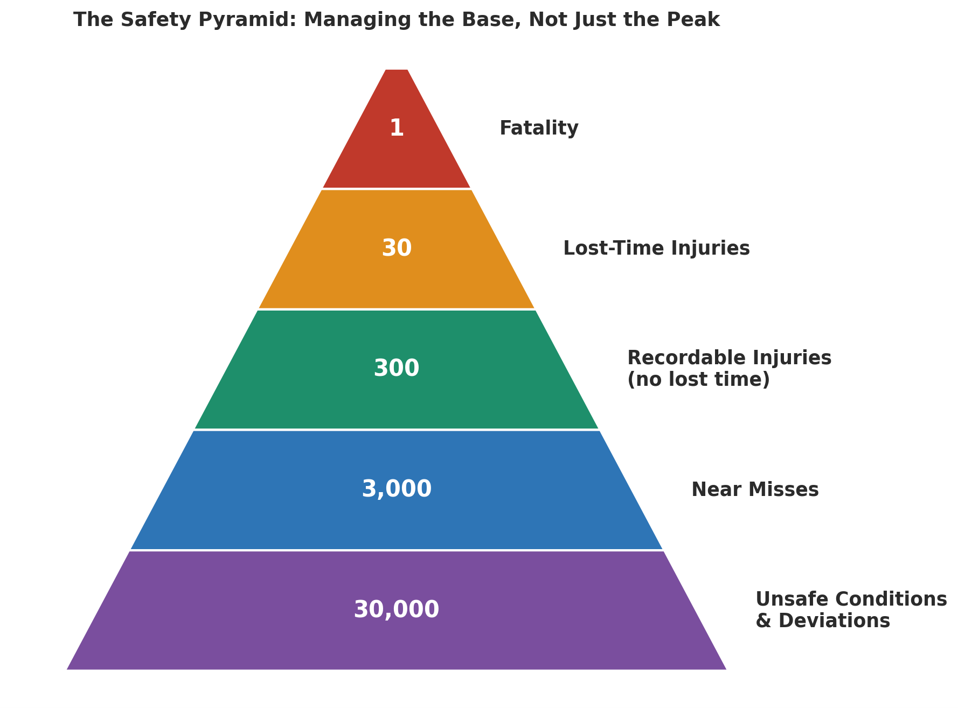
This is where a model I use often with leadership comes in: the safety pyramid. The most common reading of the pyramid focuses on the top — the fatality, the lost-time cases, the recordable incidents. But what actually needs to be managed is the base: the deviations, near misses, unsafe conditions and a highlight for critical risks that support the entire pyramid. The more actively that base is managed — the more deviations are identified, reported, and, above all, resolved — the lower the statistical likelihood of ever reaching the top. That is a leading indicator in practice: not waiting for the outcome, but managing what feeds into it.
Managing safety effectively requires organizations to focus less on the outcomes they hope to achieve and more on the conditions that make those outcomes possible. Incident investigations remain important sources of learning, but they represent only a small portion of the organization’s reality. Every day, thousands of tasks are performed safely because controls are in place, risks are identified, and deviations are addressed before they escalate. Managing the base of the pyramid means strengthening these conditions consistently through robust EHS programs and disciplined follow-through. This is where a strong safety culture is truly built
A Practical Example: The OPS! Program
I had the opportunity to implement a leading indicator that was a genuine turning point for raising EHS engagement and risk perception across an entire shop-floor team. It’s a program called OPS! — short for “Oportunidade para Segurança” (Portuguese for “Safety Opportunity”), the name works well in the original language. It is the main proactive EHS program in the organization, and the idea is simple: give anyone a way to report an unsafe condition in the workplace — an oil spill on the floor someone could slip on, a machine guard that is disabled or damaged, a task that requires excessive physical force to perform.
An employee opens an OPS!, and it gets routed to the responsible area maintenance, production, or even back to the employee who raised it, who implements the fix themselves, reinforcing a “see it, act on it” mindset.
One key to successfully implementing this tool was genuine employee participation from the very beginning of its design — they suggested names, we narrowed it down to three finalists, and the shop-floor team itself voted for the name OPS!. Once implemented, we defined the leading indicator: % of OPS! reports still open.
Notice that what matters most here isn’t a target for how many reports get opened — it’s the pace at which identified deviations get closed out. Over the years, we’ve seen that targets for opening maintenance tags, safety deviations, and similar reports tend to “pollute” the system — people open reports just to hit a number, and the program loses its purpose. With this in mind, we defined one of the organization’s key leading indicators in a way that keeps it effective, with everyone engaged and clearly informed about what’s happening.
Conclusion
None of this means abandoning TRIR or LTIR they remain necessary outcome measures, and boards and regulators will keep asking for them. But an organization that manages safety only by its lagging indicators is, in effect, driving by looking in the rearview mirror. The real opportunity for HR and EHS leaders alike is to build the systems like OPS! that make the base of the pyramid visible, engage the workforce in shrinking it, and let the outcome numbers follow naturally from healthier, better-managed conditions on the ground.
