



Plastic isn’t going anywhere. Despite decades of “the war on plastic” headlines, production keeps climbing, and packaging remains its single largest application — roughly 35 to 40 percent of all plastic produced globally. That packaging, in turn, makes up around 40 percent of the world’s plastic waste, with the US, Europe, and China accounting for 60 percent of that stream.
But here’s the reframe the industry needs to sit with: plastic isn’t even most of the packaging waste by weight, it is not even the largest amount of waste by percent. In the EU, paper and cardboard make up approximately 40 percent of packaging waste generated — more than double plastic’s share of about 20 percent, which is similar from glass. Wood adds another 16 percent, metal about 5 percent. Plastic gets the headlines, but a strategy built around “reduce plastic” alone is, at best, addressing one piece of a five-piece puzzle.
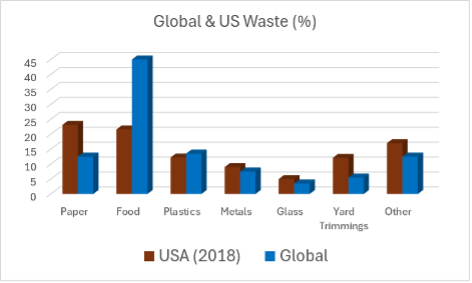
Plastics were Designed to be Thrown Away
To understand why this is so hard to fix, it helps to look back further than most sustainability conversations do — to 1963, when Lloyd Stouffer, editor of *Modern Packaging* magazine, told the Society of the Plastics Industry’s National Plastics Conference that “the future of plastics is in the trash can.”
Stouffer wasn’t being cynical; he was focused on industry growth. Seven years earlier he urged the plastics industry to focus on single use packaging. By 1963, packaging had become plastic’s largest end-use market, and he predicted it would soon become the second-largest consumer of plastics overall, behind only construction.
What’s striking, reading that speech from six decades ago, shows that single use wasn’t a goal the industry backed into. It was designed deliberately for industry growth. What we now consider “normal” packaging was based on increasing sales of plastic products. What is worth remembering when making strides in sustainability feels impossible: in many cases, we’re not adding a missing feature, the original design is being reverse engineered.
A Tale of Two Systems
We have a gap that amplifies the design problem. The US generates more municipal solid waste (MSW) per capita than nearly any developed nation yet ranks near the bottom internationally on waste recovery. Europe is known for pioneering recycling, yet currently, EU recycling rates have stagnated below 50 percent. Packaging specifically performs better in Europe, with recycling rates around 67 percent. Countries with deposit return schemes (Germany, Estonia, Sweden, Finland) and US States, like Michigan, consistently rank higher in various measures. These locales use financial incentives that support recycling programs and contribute to cleaner, less-contaminated recycling streams.
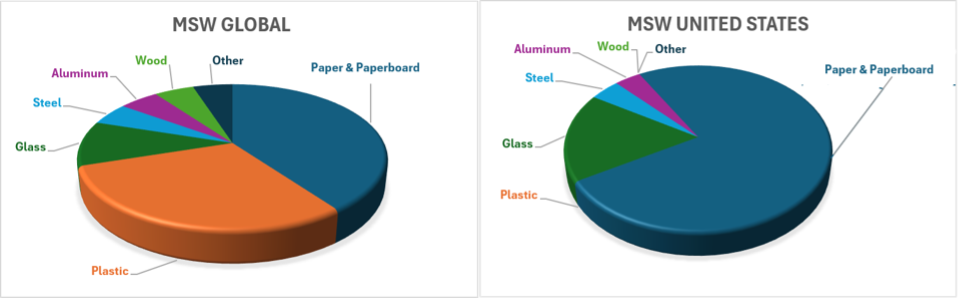
The US does not have national recycling mandates. This means waste management is handled state by state. A bottle recycled in one zip code can end up in a landfill in a zip code twenty miles away. Even when consumers do everything right, contamination and inconsistent sorting means it is possible that recycled material will go to a landfill.
Plastic vs. Packaging and Why this Distinction is Important
“Plastic” and “packaging” get used almost interchangeably, but they are different: plastic is a material category, packaging is an application. A plastic bottle, a plastic toy, and PVC piping have distinct lifecycles and regulatory management. These factors are central to Extended Producer Responsibility (EPR) policy, which is expanding state by state in the US. These policies place financial and operational responsibility for packaging waste on the companies that sell it or the product it contains, regardless of material. Knowing where your packaging falls within these frameworks isn’t optional anymore; it’s a compliance requirement with real cost implications.
Where Advancement is Most Likely Headed
Innovation is important and it will be paired with a realistic outlook on end-of-life across all materials. Some categories to watch in the future:
- Material substitution: examples include plant-based plastics from agricultural byproducts, bamboo-based cartons, cellophane as alternatives to petroleum-based plastics
- Design innovation: designs such as oxygen-leak indicator tape for modified atmosphere packaging that reduce food waste by signaling spoilage early a reminder that packaging waste and food waste are linked.
- End-of-life advancement: implementation of robotic sorting systems addressing contamination at recovery facilities, specialty programs like TerraCycle, Sway, Innovation 4 Waste, etc. for hard-to-recycle materials, and early research into non-commercialized technologies, such as self-degrading, bacteria-embedded materials.
The gap between going to market with promising ideas and that will replace or enhance systems already shipping hundreds of thousands of units a year remains enormous. Most of that work happens in low-volume production environment. Companies with the ability and flexibility to test before scaling up will be needed. Larger CPG players are piloting alternatives, but most large-scale implementations are based on traditional Return on Investment models that are not designed for greenfield solutions, but rather to leverage existing infrastructure. Currently, what is considered a robust and sustainable package means the waste system puts the packaging in a different spot at end of life, versus processing to reduce waste.
The Call to Action
For anyone working in or around packaging, the path forward starts with education — and then action.
- Map your full material mix, not just plastic, against the realistic recovery infrastructure in the markets where packaging ends up.
- Get ahead of EPR requirements now, while they’re still emerging, rather than reacting once they are in place and being enforced.
- Resist the substitution trap: swapping plastic for paper or any other material need because it meets KPIs is not the same as improving the end-of-life for packaging.
The packaging industry has a sixty-year lead on designing for disposal. Reversing will require more than new materials. This will require an ability to evaluate every material systematically against existing systems and build packaging strategies around what happens after the product reaches the consumer. The work that ahead for the packaging industry means to set the standard versus scrambling to meet it.
