



ShelterBox responds all around the world when people have been displaced from their homes by a disaster. Since 2000 that has added up to over 300 responses in about 100 countries. And whether the families are fleeing due to a weather event or a violent conflict, both are happening more frequently and with greater severity due to climate change.
Delivering essential aid in these situations is vital, but we can’t ignore that our actions also have an environmental impact. I heard once of a volunteer fire department who funded their operations by operating a fireworks stand for the 4th of July. Are we creating a self-fulfilling prophecy?
At ShelterBox, we are committed to environmental sustainability, balancing our humanitarian work with environmental responsibility. We’re working hard to make our operations greener and reduce our carbon footprint.
By integrating sustainable practices into everything we do, from head office efficiency and procurement to logistics and community engagement, we can drive systemic change and contribute to a greener, more resilient future for humanitarian aid.
We’re making progress!
Green electricity. We switched to 100% renewable electricity at our head office, cutting costs by around 16% and reducing our carbon footprint.
Plastic reduction. We replaced non-essential plastic packaging with paper alternatives for items like kitchen sets. From now on, all our core aid items will follow minimal packaging standards. Over the last five years we have avoided using more than 500,000 pieces of problem plastic packaging. This change also makes it easier for us to import these items into countries where single-use plastic is prohibited, meaning help arrives that much sooner.
Environmentally friendly aid items. We found environmentally friendly alternatives for many of our aid items, including blankets, sleeping mats, buckets, and tarpaulins. We’re also working with our supplier to evaluate and redesign our family tents to minimise their environmental impact, for example, by using recycled material that contains less chemicals that lead to pollution.
Pre-positioned stock. By increasing our number of strategic storage locations, we can move our stock closer by sea before a disaster and minimise air freight. This allows us to maximise the speed of our response and minimise freight emissions.
End-of-life use
Choosing reusable and recyclable aid items, when possible, means they can have a life after having served their original purpose. There are a number of inspiring stories from Mozambique, Morocco, and Somalia.
Finding new uses for aid packaging in Mozambique
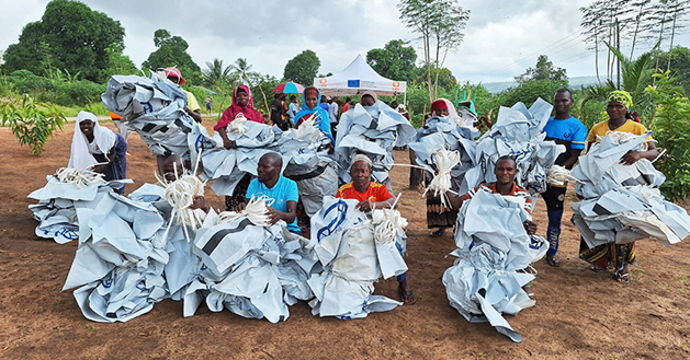
Credit:Care Mozambique
Image Description: The committee assembled by Care Mozambique pose with collected plastic tarpaulin bags and leftover strips
https://shelterbox.org/blog/finding-new-uses-for-aid-packaging-in-mozambique/
When we support communities after disaster, we aim to avoid adding to the challenges people are already facing. This aligns with the ‘do no harm’ principle, where we commit to minimising any environmental impact on affected communities.
As part of this we want to reduce the amount of waste from our aid materials. Aid items like tarpaulins need to be wrapped during shipping to protect them. Our partner in Mozambique has been giving aid packaging a new life. They collect plastic tarpaulin bags and baling straps which can be used to improve shelters. These are then offered to families where the need is greatest.
Some tarpaulin packaging and straps are being used to create walls and doors for latrines. Women said that they had faced harassment when using the latrine. The added walls and doors offer more privacy and reduce these incidents. It’s a great example of how reusing waste can help a community.
Members of a Women and Girls Safe Space have been reusing waste materials by turning leftover bags and tarpaulins into carpets. They also plan to create items like baskets and footballs from these materials.
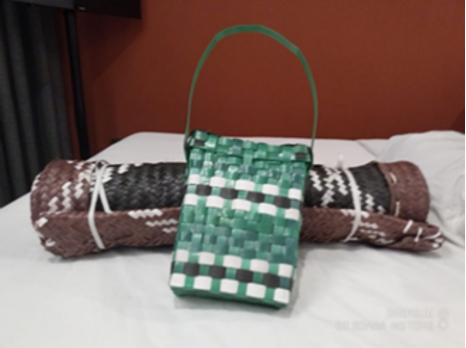
Reusing and recycling our aid packaging in Morocco
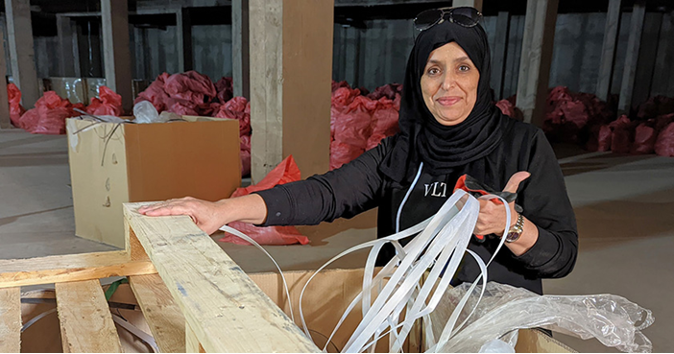
Credit: Le Foundation Grand Atlas, ShelterBox
Description: Habiba Guonaine poses with a wooden pallet and strips of plastic
https://shelterbox.org/blog/re-use-and-recycling-of-our-aid-packaging-in-morocco/
Some packaging is necessary so we can ensure items keep in good condition during transit. This usually consists of plastic strapping, bags, poly-propylene woven sheets and cardboard boxes, often transported on wooden pallets.
After an earthquake in Morocco we had over 330 wooden pallets in our warehouse in Marrakech. We didn’t want them to be thrown away or cause issues for the village communities we were supporting. With some research these items were put to good use.
A local volunteer arranged for the plastic to be taken to a recycling centre. It was ground down, made into pellets, and used to create new items, including kitchen utensils, bottles for cleaning supplies, and rubbish bags.
Some of the pallets and cardboard made their way to where we were working in the Atlas Mountains. The pallets became flooring in shelters, keeping mattresses off cold and muddy ground. The cardboard helped insulate the single-walled tents some people had been living in since the earthquake. The poly-propylene woven sheets were used to patch up shelters. They also helped keep ground water and mud out of tents.
These simple initiatives not only reduced waste; they also helped to keep families warm and dry at a time of year when temperatures plummet in the mountains, and snowfall is common.
Somalia’s climate crisis meets innovative solutions
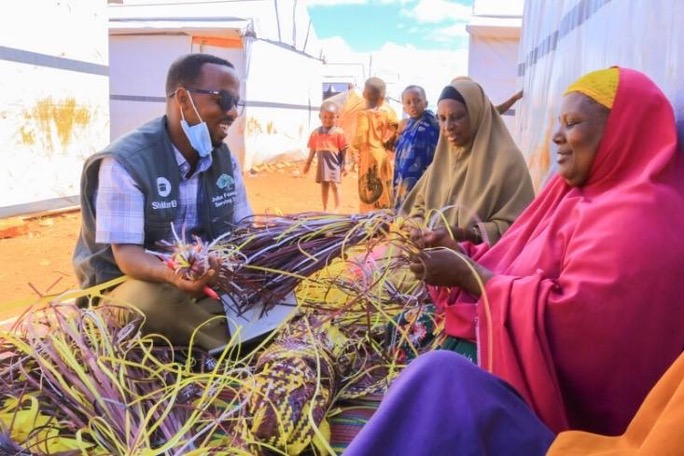
Credit: Juba Foundation, ShelterBox
Description: Halima (pink head-scarf) talking to ShelterBox partners, Juba Foundation
Details of the image asset Plastic Recycling Story | Asset Bank
Somalia has been grappling with intense climate challenges, political instability, and economic pressures. The country is in a constant humanitarian crisis, with frequent flooding destroying farmland and displacing hundreds of thousands of people.
ShelterBox supported 2,600 households with essential toolkits and tarpaulins to shield people from the relentless rains and scorching heat. The package was used creatively too, with community members transforming the bale straps into woven baskets. This innovative repurposing not only diverts waste from landfill but also creates new economic opportunities for the community.
There’s still room for improvement
ShelterBox helps more people every year. But due to climate change, our goal of “No One Without Shelter After Disaster” keeps getting farther away. So, we have to play both smarter and harder.
Sustainability is not a one-size-fits-all solution; it is a dynamic approach that should be part of all our operations. We’re learning and evolving with each step. Small, sustained changes will lead to big impacts.
